Summary
Rendered output
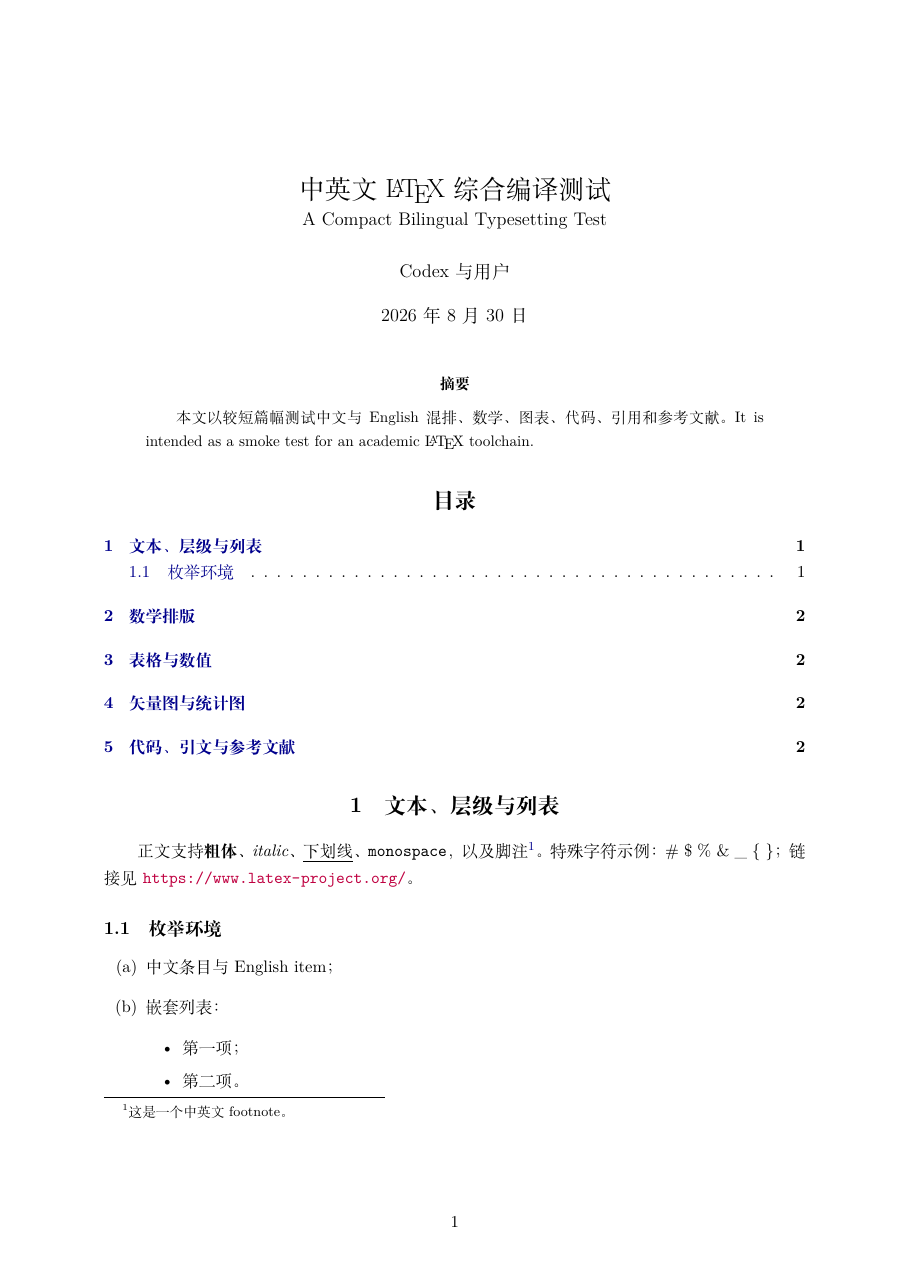
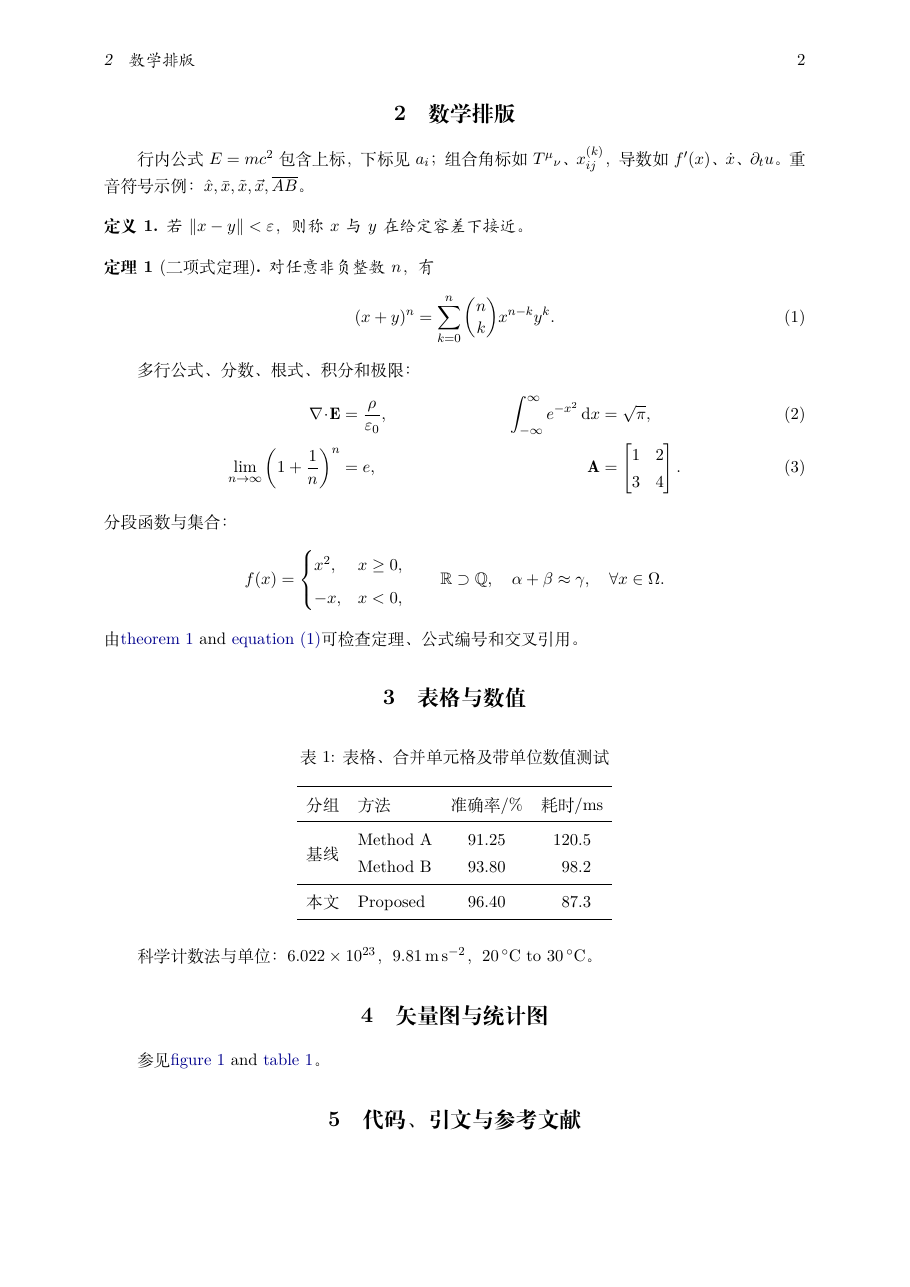
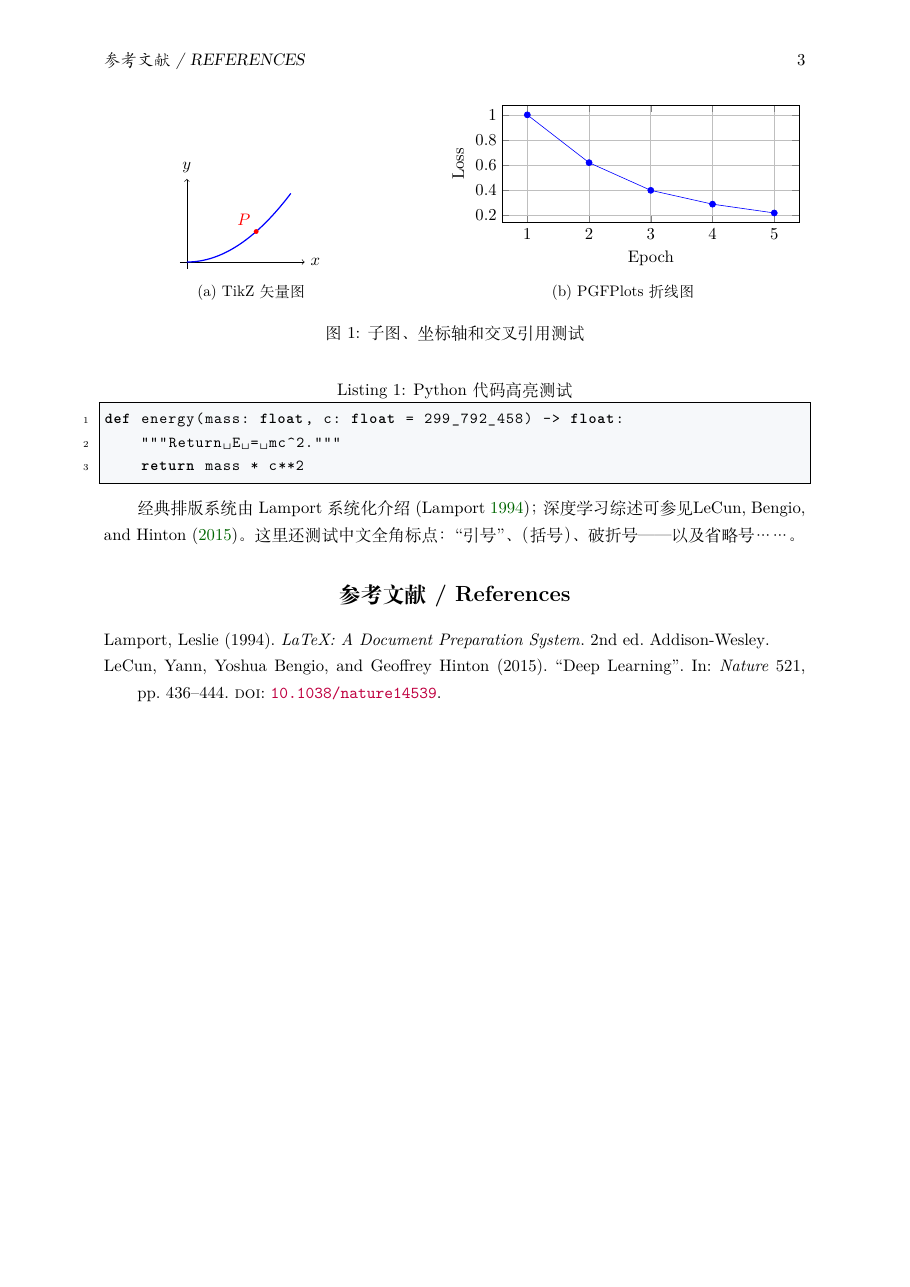
These pages are the actual output of the successful XeLaTeX and Biber build. Select a page to view it at full size. Together, they show the document structure and bilingual text, mathematics and tables, vector figures, code, and references.
1. Test objectives and scope
The test directory contains the main document, a BibLaTeX database, build instructions, and records of font-related failures. The test verifies the complete source-to-PDF workflow and checks that key elements render without missing glyphs, placeholder boxes, overlap, or clipping.
This is not a font-quality benchmark, print-color assessment, or PDF/UA accessibility audit. The sample data is for typesetting tests only; any accuracy or timing values shown in its tables are not experimental results.
2. Coverage matrix
| Capabilities | Coverage | Verification result |
|---|---|---|
| Bilingual text | Chinese and English, bold and italic text, monospaced text, footnotes, and full-width punctuation | Passed |
| Document structure | Title, abstract, table of contents, sections, nested lists, and page numbers | Passed |
| Mathematics | Subscripts, accents, matrices, piecewise functions, integrals, limits, theorems, and equation numbers | Passed |
| Tables and units | booktabs, multirow, siunitx, decimal alignment, and scientific notation | Passed |
| Vector figures | TikZ curves, axes, annotations, and subfigures | Passed |
| Plots | PGFPlots lines, grids, axis labels, and legends | Passed |
| Code listings | Python syntax highlighting, line numbers, wrapping, borders, and monospaced fonts | Passed |
| Cross-references | Links to theorem, equation, table, and figure numbers | Passed, with a localization issue noted |
| Bibliography | Biber, author–year citations, DOI links, and reference entries | Passed |
3. Minimum reproducible process
The main document uses ctexart for Chinese and Unicode support through XeLaTeX. biblatex uses Biber as its backend, while latexmk runs XeLaTeX and Biber as needed until the build converges.
# Build
latexmk -xelatex main.tex

# Force a full rebuild and stop on errors
latexmk -g -xelatex -interaction=nonstopmode -halt-on-error main.tex

# Remove intermediate build files
latexmk -C4. Layout verification and follow-up items
4.1 Passed checks
- All three A4 pages render correctly, with legible Chinese and Latin text and no missing glyphs or placeholder boxes.
- Matrices, integrals, piecewise functions, and multiline equations stay within the page; table values remain aligned.
- TikZ and PGFPlots figures remain crisp, with a clear hierarchy between subfigure captions and the main caption.
- Biber produces two complete references with author–year citations and working DOI links.
4.2 Non-blocking issue
cleveref still labels references in English (for example, theorem, equation, figure, and table). For a Chinese-only paper, define localized names or review the package language options and loading order. The sample also renders the word to in a Celsius range; formal Chinese documents should use a consistent Chinese range marker.
5. Desktop font rendering issue
After installing the Chinese TeX Live components, Chinese character spacing may temporarily look wrong in a desktop terminal or an Electron/Chromium app. The evidence points away from the LaTeX build chain: installation changes the system Fontconfig fallback order, while long-running graphical apps may retain stale font caches or mappings.
- Record
fc-matchoutput and package changes before and after installation so the results can be compared. ctexunder XeLaTeX can use TeX Live's bundled Fandol fonts; basic Chinese support usually does not require changing desktop fonts.- After changing fonts, rebuild the Fontconfig cache and fully quit and restart apps that render text. Restart again if the cache still appears inconsistent.
- Specify fonts explicitly in the source when possible to reduce dependence on the desktop's default fallback chain.
6. Redactions and environment details
This report includes commonly used package combinations, build commands, verification methods, and failure mechanisms. It omits absolute source paths, local usernames, host identifiers, user-level configuration, installation logs, and other details tied to a specific environment. The author field is presented as a toolchain-validation label.
7. Conclusion
This test confirms that XeLaTeX, ctex, TikZ/PGFPlots, listings, cleveref, siunitx, and Biber can form a compact, reproducible baseline for bilingual research typesetting. The core features render as expected. Further work should address localized reference names and unit-range wording rather than expand the test matrix.